When you take a
flower in your hand and really look at it,
it's your world
for the moment. I want to give that world to
someone else.
Most people in the city rush around so,
they have no
time to look at a flower. I want them to see
it whether they
want to or not.
- Georgia O'Keeffe (Artist)
In an earlier Micscape article, I
investigated two members of the Passifloraceae
family – Passiflora caerulea,
and Passiflora coccinea x incarnata.
In
this article, I will describe the extremely beautiful hybrid Passiflora x belotti, which was
produced by crossing P. alata
with P. caerulea.
Unlike the other two species, this one has an absolutely wonderful
scent.
In 1824, Dr. Lindley named this
hybrid Passiflora alato-caerulea,
and
over the years it has been given other names: Passiflora munroi, Passiflora pfortii, Passiflora x belotii, etc.
Today, one of the commonest names is Passion Flower ‘Imperatrice Eugenie’. The
dedication is to the wife of Emperor Napoleon III.
All Passion Flower blooms are
strikingly complex, and seem almost alien when compared with simpler
flowers. Sepals, petals, coronal filaments, and reproductive
structures all combine to form an amazing botanical spectacle.
As usual, my purpose is to show
that the beauty of a flower, when viewed from a distance, is only part
of the picture. When viewed close up – very close up, the structures that
combine to form the flower have a beauty all of their own! (Note:
As the camera moves closer to a large flower, it becomes more and more
difficult to keep everything in the picture in focus.
Photographers refer to this as a ‘depth of field’ problem, and it
requires a particular part of the flower to be chosen to be ‘in
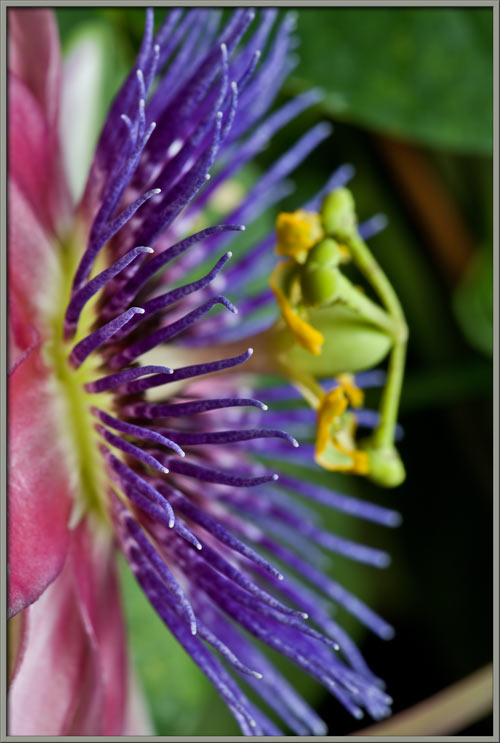
focus’. In the image on the left below, I have chosen the purple
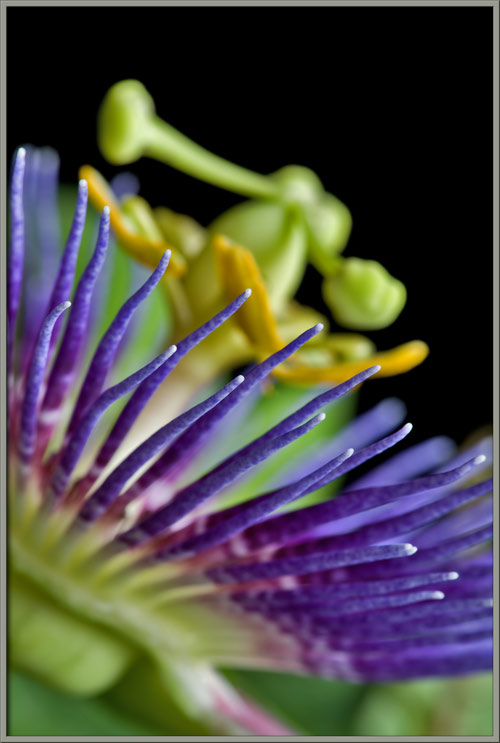
coronal filaments to be in focus, while in the image on the right, I
have chosen the more distant reproductive structures to appear in
focus.) If you look at the image on the right, you will notice
that the flower’s reproductive structures (stigmas, ovary, and anthers)
are held by a sturdy green, rod-like structure which is called the androgynophore.

As the camera moves closer to a
flower, this depth of field problem becomes more severe.
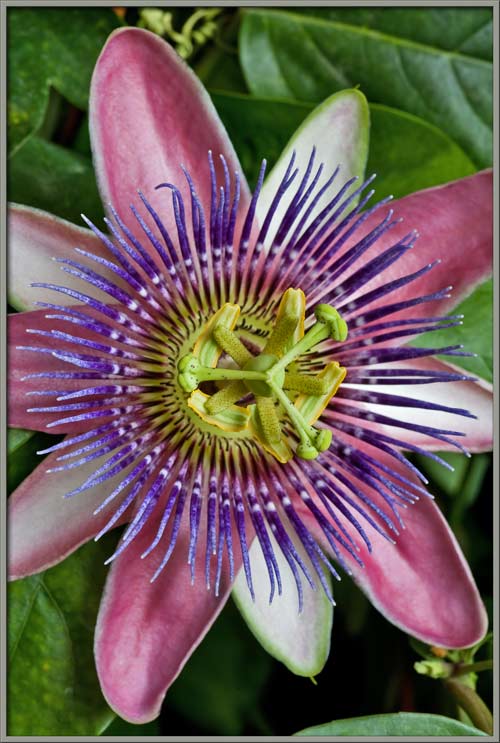
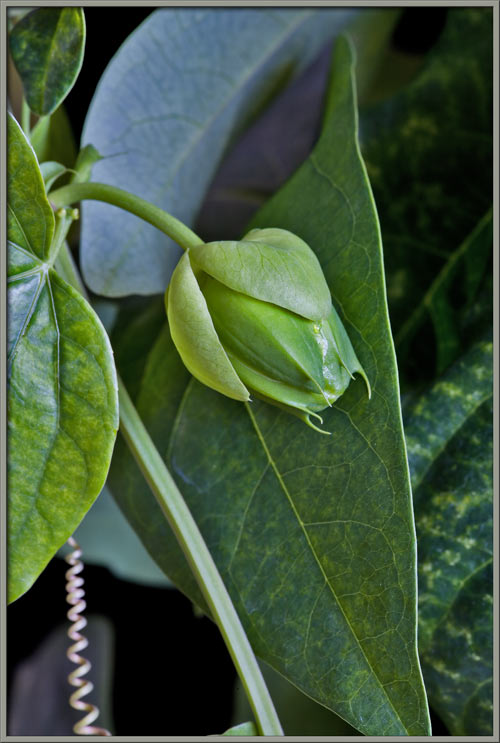
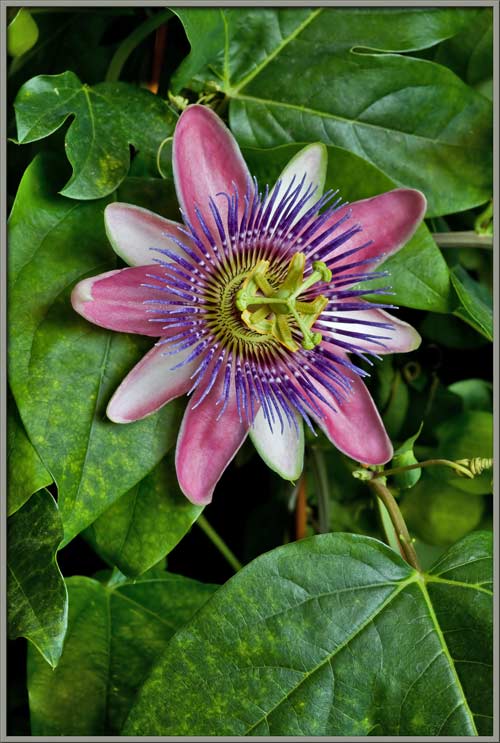
A mature Passion Flower bloom can
be seen below. What however, did the bud stage look like?
The answer can be seen in the image
that follows. Keep in mind that the Passion Flower plant is a
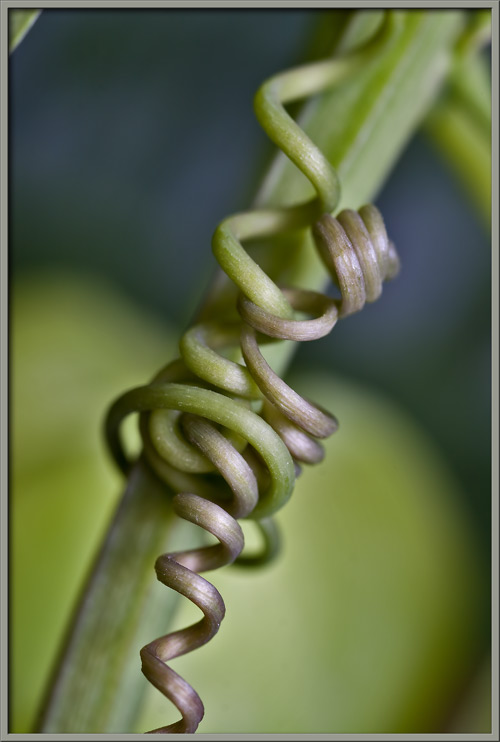
vine that holds itself aloft by having its tendrils curl around nearby
plants, or other inanimate structures. One such tendril can be
seen in the image. Notice in particular, the strange, tiny
bulbous structure growing from the leaf stalk, just to the right of
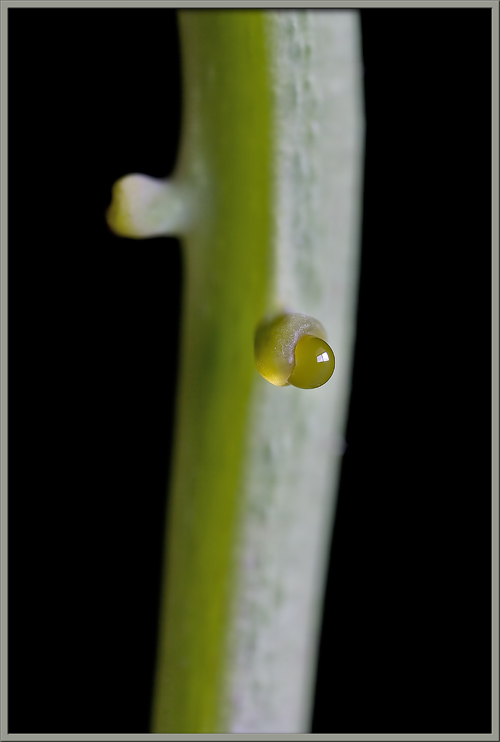
centre in the image. This is a nectariferous
gland.
Much closer views of a
nectariferous gland can be seen below. These glands produce a
sweet, viscous liquid called nectar that attracts insects. In
some species, the nectar attracts insects to help fertilize the flower,
and other species, it attracts insects that devour a particular
predator that might eat the plant’s tissues, or suck the juices from
them.
Three additional images that show
these glands can be seen below. If no insect partakes of the
liquid refreshment supplied by the glands, the droplets become so large
that surface tension can no longer hold them in position, and they fall
onto whatever is immediately beneath.
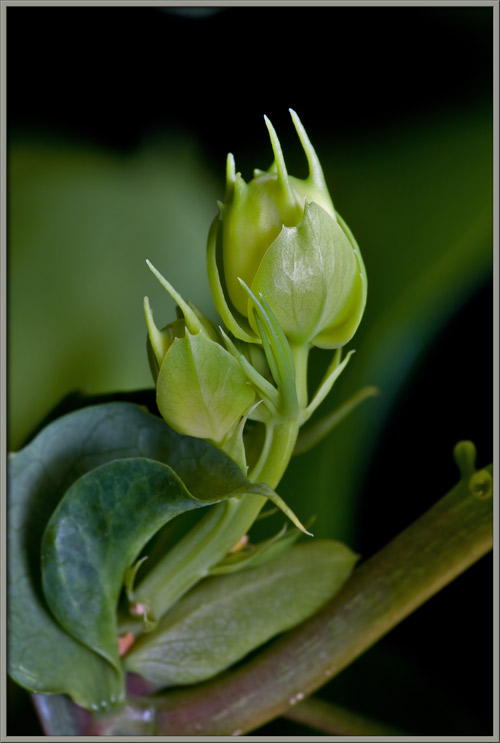
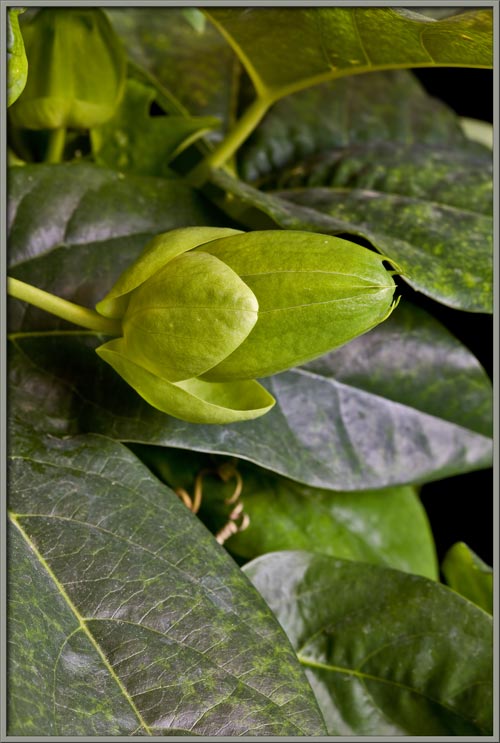
Let’s return to the bud-stage of
the blooming process. The bud is protected by three modified
leaflets. Within this protective envelope, there are five sepals
(modified leaves) which in turn protect the flower’s petals. Each
sepal is tipped by a slender spike.
These modified leaflets and sepals
can be seen more clearly in another bud.
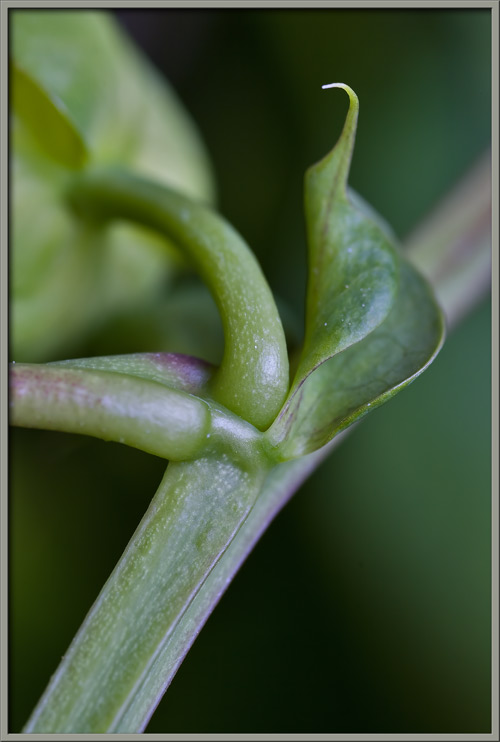
Notice the interesting structural
engineering involved at the point of connection of a bud stalk to the
main vine. The two stalks which angle directly left are connected
to leaves.
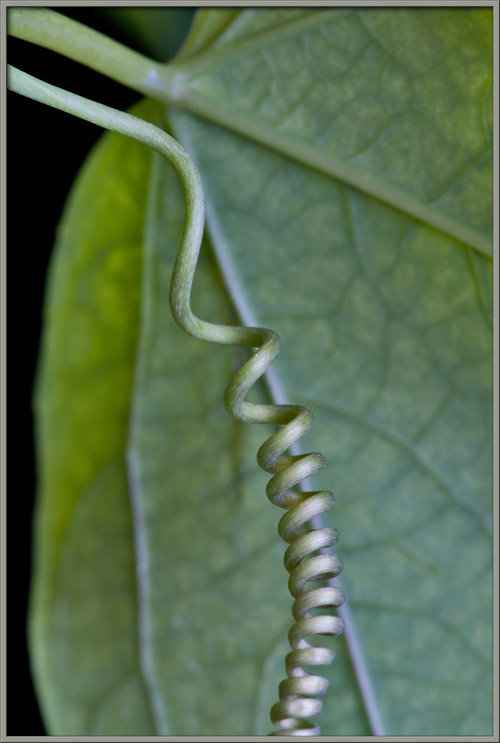
Tendrils that have not come into
contact with something to hold on to, seem to form neat, regular coils.
However, when a tendril does find a
‘foot-hold’, it certainly seems to make certain that it won’t be
dislodged!
Over a period of many days, each
bud grows in overall size, with its length increasing faster than its
diameter. Notice that the length of the sepal spikes has not kept
up with the overall growth.
Eventually, the sepals begin
to separate as the time of blooming approaches. This reveals the
pale pink colouration of the flower’s petals beneath.
This stage can be seen more clearly
in the images that follow. Both the sepals and petals of the
Passion Flower are thick and fleshy. If you look carefully, you
can see that the sepals have begun to lose their green colouration
along the edges. Interestingly, the inner surface of each sepal is
white.